Compoze
2025 · sole founder · sold to a client
Compoze was an evenings-and-weekends company, run alongside my full-time job at TikTok. It built assistants that answer questions from a company's own documents, and it was sold to a client at the end of 2025.
The idea was to help staff find answers in company documents without searching through them by hand. Compoze included the sources with each answer so people could open them and check.
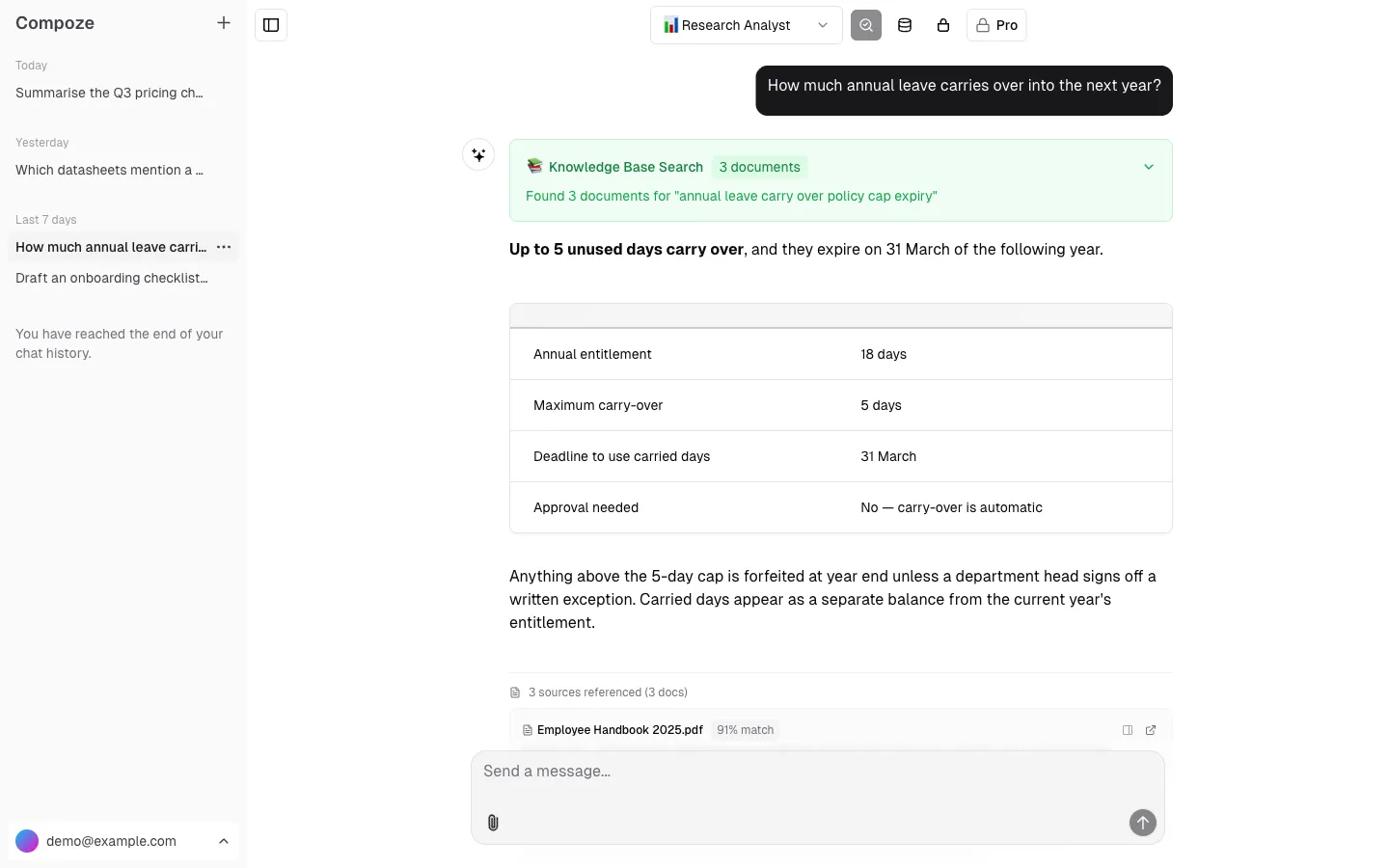
Figure 02 · User flow
An admin fills the knowledge base, then a user asks questions
An admin connects Lark or Drive and watches each document until it is ready or fails. A user picks an agent, starts from example prompts, and gets a cited answer, or a refusal when nothing clears the 0.35 floor.
- Admin
- User
- Answer
Working alone
Each engagement ran from the first customer conversation through deployment and training, and I handled all of it. Organising the knowledge base took the longest, because only the customer could decide which documents belonged in it and which should stay out. Running Compoze beside a full-time job also meant it had to keep working without constant attention.
Figure 03 · The whole system
How a question and a document move through the system
A question walks agent, retrieval, pgvector, gateway and cited answer inside one request. Ingest runs on QStash workers and lands in the same Postgres.
- Request
- Response
- Ingest
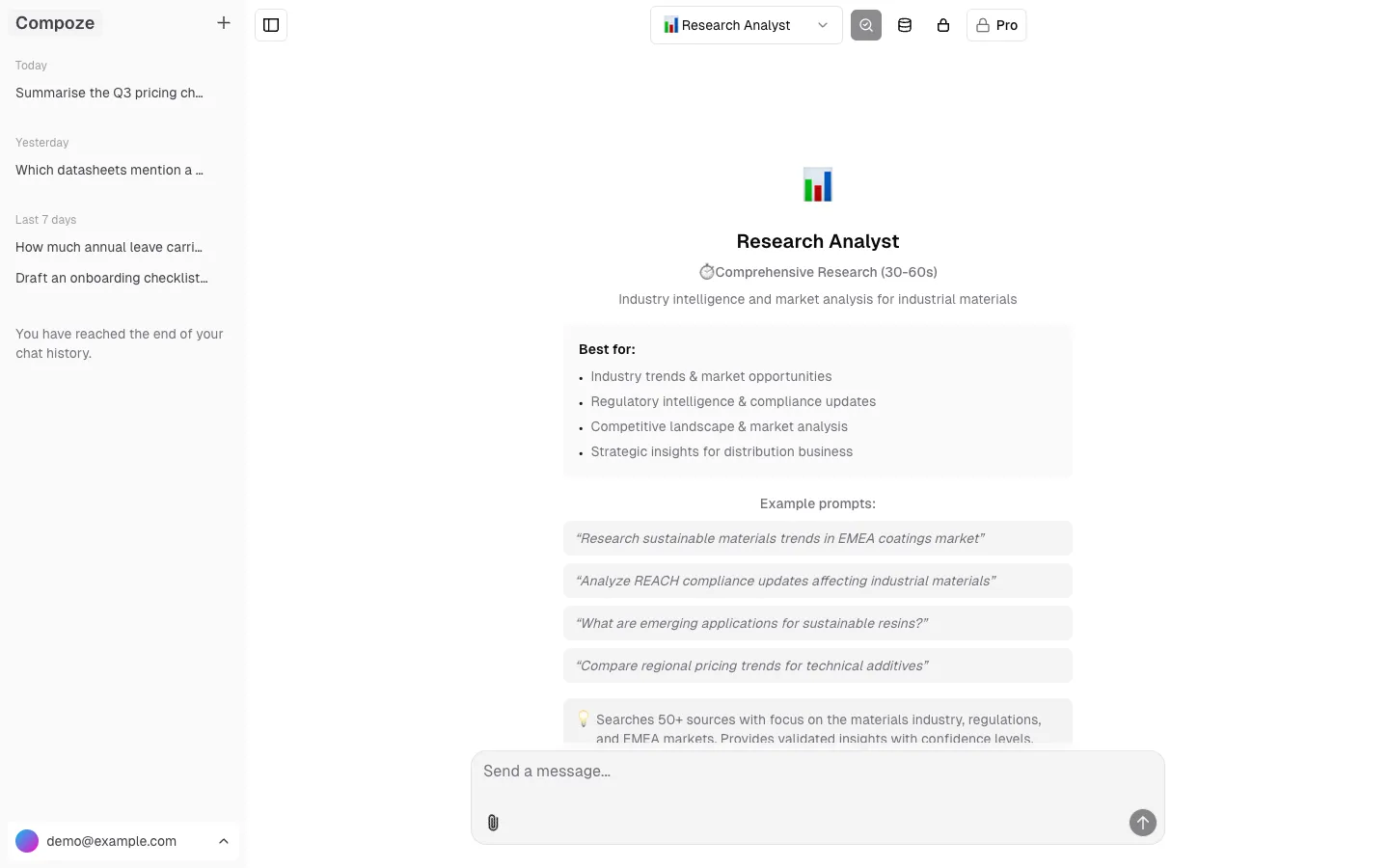
The chat opens with example prompts and a list of the tools it can use, so someone new can see what to ask. Past conversations stay in the sidebar.
One codebase, configured per customer
Compoze ran on two stacks: a Python assistant on LlamaIndex and FastAPI with managed indexing on LlamaCloud, and the platform described here. That platform is Next.js 15 and React 19 on the front, Postgres with pgvector behind Drizzle. Every core table carries a tenant id. Tenant checks in the application and Postgres row-level security provide two layers of isolation. One shared database keeps migrations and billing in one place, while tenant scoping has to stay consistent across both layers. On top: three roles (Admin, Manager, User), an admin portal per tenant, and nine models from OpenAI, Anthropic and Google behind one gateway, picked per environment in configuration.
Finding the right passages
Documents are chunked at about a thousand characters. Each chunk gets a one-sentence header placing it in its document and is embedded with OpenAI at 1536 dimensions. A question runs across up to five knowledge bases in parallel. Each lane is hybrid: cosine search over an HNSW index, keyword search beside it because dense search misses exact tokens, the two ranked lists merged with reciprocal rank fusion. Chunks under a 0.35 similarity floor are dropped. An LLM scores the survivors per database, and a cross-encoder reading question and chunk together sets the final order.
Figure 05 · Query
How a question searches five knowledge bases and checks its citations
A question fans out across five knowledge bases with hybrid search. Only chunks over the 0.35 floor survive, a cross-encoder orders them, and each citation is checked against its chunk before the answer ships.
- Question
- Retrieval
- Answer
Citations are stored with the message, checked for entailment against the sentence they support, and rendered with their match scores. The source links and scores let readers check how well a passage supports the answer.
The prompt is fixed blocks (role, rules, context tagged with chunk ids, history, question) so the static prefix caches per tenant. The rules: answer only from the context, name what is missing, and refuse when the best chunk sits under the floor.
How I knew it worked
A fixed set of question and answer pairs came from logs and testing, including questions the documents couldn't answer, where the expected reply was a refusal. Retrieval and generation are scored apart: context precision for whether the good chunks ranked high, faithfulness for whether each claim is entailed by what came back. The set runs in CI, and a prompt, chunker or model change fails on a regression against main. The comparison is against the previous version rather than a fixed score threshold.
Getting the documents in
Files come from Lark and Google Drive over OAuth, with an MCP server for Lark docs, wiki, sheets and bitable. Ingest is async through QStash: download, extract with LlamaParse, chunk, batch-embed, store. The failure paths took more of my time than the happy one, because a run that dies after the download leaves a document that looks uploaded and answers nothing.
Figure 06 · Ingest
How an uploaded document is processed, and where failures go
A content hash drops files already seen. PII comes out before chunking. The dashed region runs later on QStash, and every stage can drop out to a dead-letter queue the admin UI shows.
- Document
- Failure
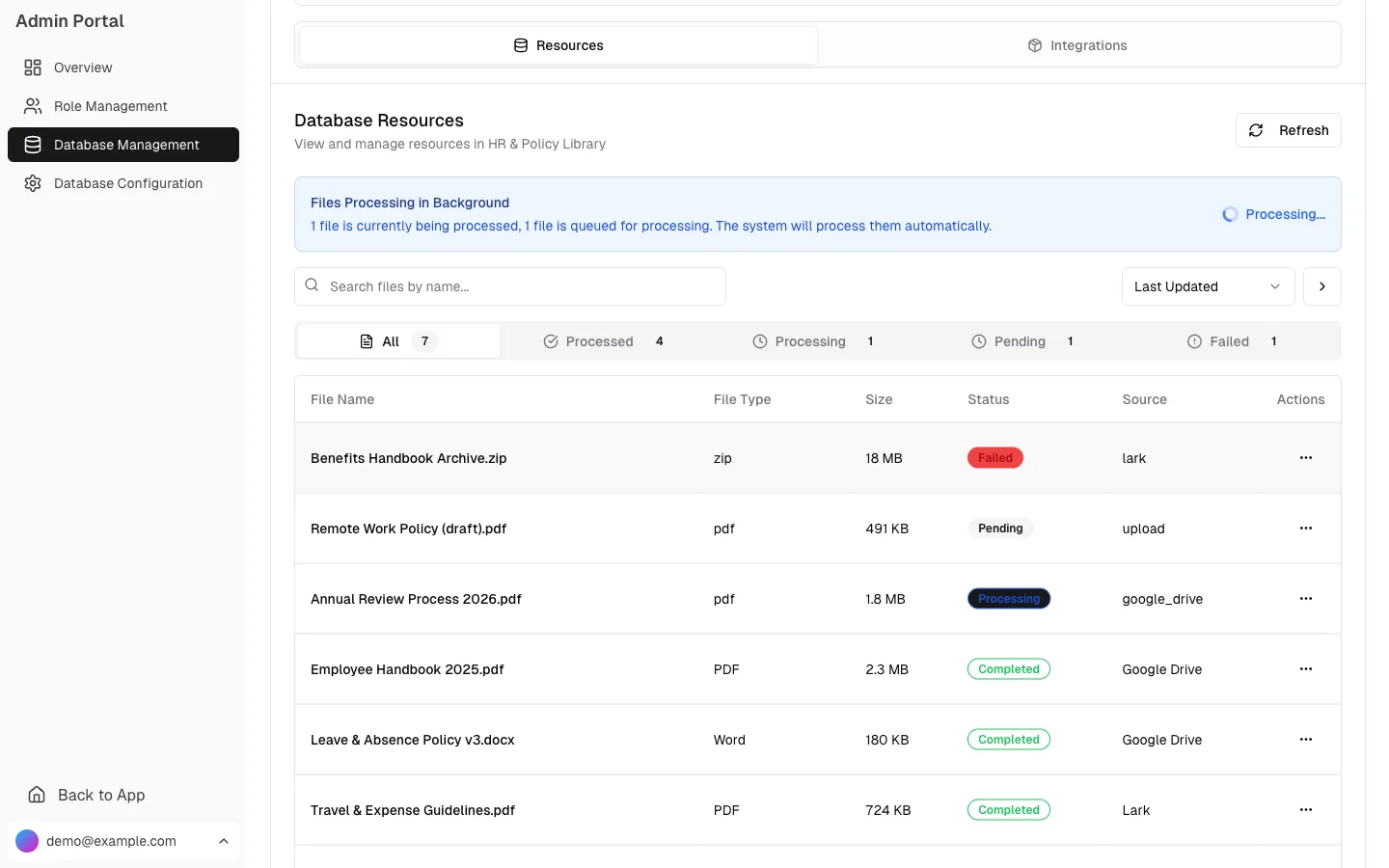
Jobs are keyed by content hash, so a re-upload is a no-op; embeddings are cached by chunk hash and model, so editing one paragraph re-embeds one chunk. PII is redacted at ingest, which keeps the embeddings clean. Anything that exhausts its retries lands in a dead-letter queue with the payload and the error attached. That gave me a record of what failed and what needed retrying.
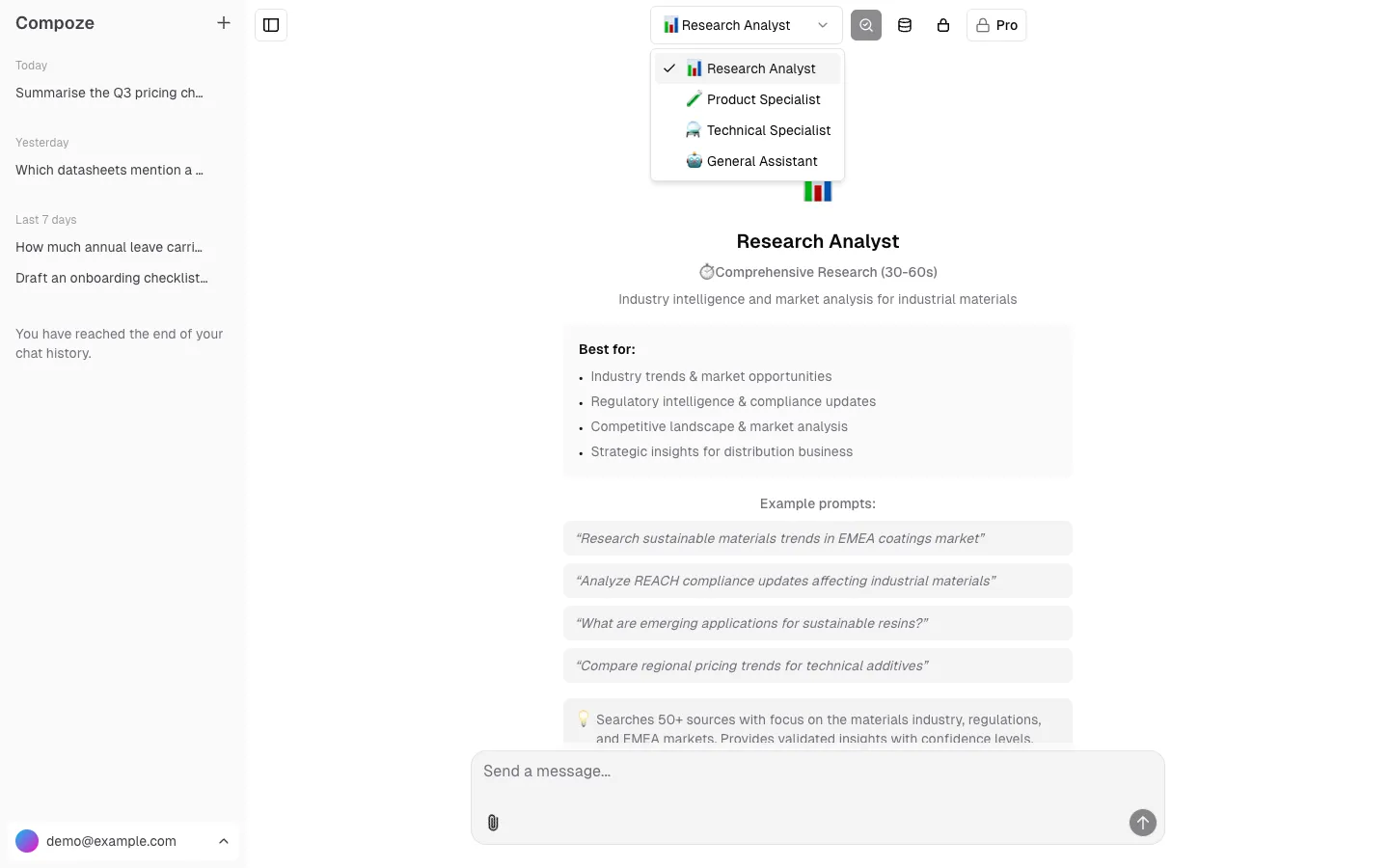
Nine tools: contextual RAG search, retrieve, summarise, read, create and update a document, web search, extract and crawl.
Safety
Retrieved text is untrusted input. An instruction planted in a synced document can influence the model, so context arrives in a delimited block the prompt declares as data. Tools are scoped per agent and tenant connector. These controls limit which tools the model can call. They do not guarantee that the model will ignore a planted instruction.
Implementation inventory
- domain agents
- 4
- agent tools
- 9
- models / providers
- 9 / 3
- knowledge bases per search
- 5, in parallel
- similarity floor
- 0.35 cosine
- test specs
- 27
- api routes
- 53
- database tables
- 23
- typescript
- ~76k lines
Figure 09 · Chat
The answer keeps generating if the reader closes the tab
Chat streams by default. If the client disconnects before the stream completes, an abort listener hands the job to a QStash workflow. Each phase is a durable step, so a retry resumes after the last one that finished.
- Question
- Tokens
- Hand-off
Optimisations and operating details
Chat streams by default. If the client disconnected mid-answer and the stream had not completed, an abort listener handed the job to a QStash workflow. Each phase (init, load context, RAG query, generation, finalise) was a durable step, so a retry could resume after the last completed phase. When QStash was unreachable the route fell back to plain streaming.
Edge middleware replaced any client-supplied identity header with the user and tenant id from the verified JWT, so routes trusted it and skipped a database round trip. Indexes led with the tenant id, and chat creation was an atomic insert-on-conflict.
- cursor pagination
- fetch limit + 1 to learn whether a next page exists, no COUNT
- adaptive polling
- 3s while processing, 5s while pending, 30s idle, previous data kept so the table never flashes
- connector caches
- per-connector LRU with per-action TTLs for Drive and Lark, plus a sliding-window rate limit per tenant
- sse anti-buffering
- no-transform cache headers, X-Accel-Buffering off, framework compression disabled, per-route duration budgets on fluid compute
- tool surface
- only the tools the agent and the tenant connectors allow reach the model, with a tighter step budget on background runs
With no one else reviewing the code, automated checks did that job. Route contracts are typed, every payload is validated at runtime with Zod, and contract tests run on each push. Those checks let me keep changing 53 routes and 23 tables on my own. Each request is traced as one span tree with tokens, model and tenant on every span, so pricing is built on cost per tenant per answer. The latency I watched most closely was time to first token.
// NEXT
UI Pack
The design system behind these figures